

antalistvan1968
Member
Now Fosi Audio's new product, the MD3 portable dac/headphone amp, is being reviewed and introduced in my user presentation. The company has already started down this path before, namely with the DS3 small device, which was a real winner for me. The new product is available in two colors, black and silver.
Let's open it and see what's in the nice design box:
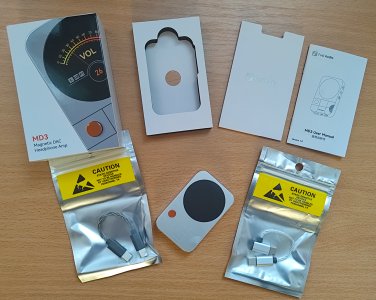
MD3 dac/headphone amp
Two USB cables in two different designs.
User manual
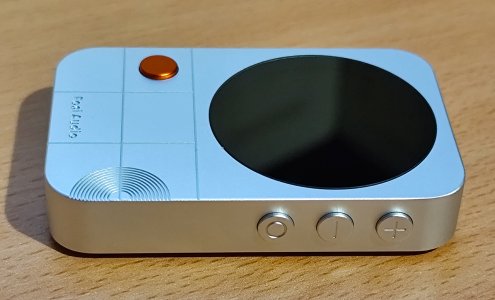
The MD3 is simply beautiful in this silver color to me. The aluminum housing with the round display and the orange leather covering on the back on the magnet exude a kind of luxury. This protects both the phone and the MD3 itself from scratches that could occur when rubbing against the back of the phone. The use of materials: Aluminum housing and leather milled from a single block, the display is a 1.28' LCD. In any case.
I have an extra luxurious feeling.
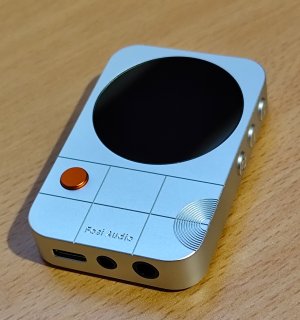
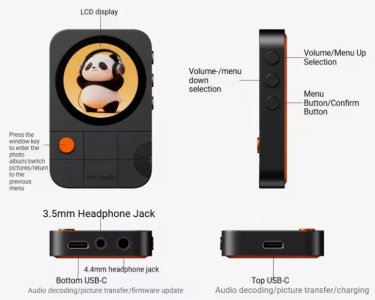
On the top there is a usb-c socket, and on the bottom from left to right there is a usb-c socket, then a 3.5mm jack and finally a 4.4mm jack balanced output.
The two usb outputs can be used equally to receive music and image files, and the one on the bottom can also receive updates. It is also suitable for charging the phone while in use. The design of the two usb cables is different so that the MD3 can cover all kinds of situations when placed on the phone or even when using a laptop, tablet, etc. This is a good point.
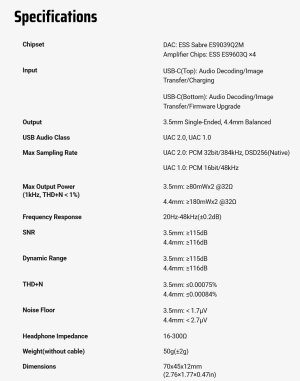
Some technical data, but only tangentially. They can be found in detail on the manufacturer and distributor's website. There is no point in repeating the manufacturer's data in a user test. The dac chip: ES9039Q2M flagship chip.
The picture should tell the story about the performance, frequency transfer, power consumption, etc.:
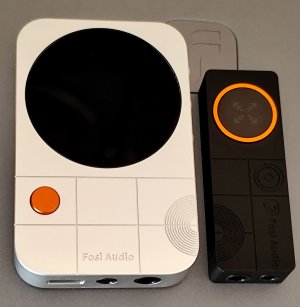
The big and little brothers next to each other:
Let's plug it into the phone and see what it this:
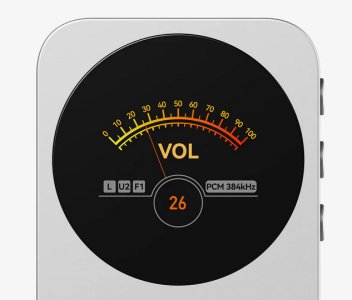
It has a very nice display. The picture is sharp and the brightness is adjustable. This VU meter is beautiful. It's a pity that it's not a working meter, or at least an animated image. However, if we switch, there's a tape cassette reel that rotates and a vinyl record, very cool. It's really a shame about the VU meter, it would have been nice even if it didn't show real data, only random moved. However, it shows the volume level setting, so it still has a function. Overall, the animations look very good. We can also view images on the MD3's display. Although the phone at hand or other device connected to the dac can do this on its own. There is a web application for the MD3 that allows you to edit images and upload them to the DS3 dac. Link:

 cc.fosiaudio.com
The menu is clear and easy to use. The display can be rotated, so you can use the device in any position. Of course, it can be used not only with mobile devices. The dac/amplifier is also suitable for other devices.
The magnetic back is only possible with many devices by using a suitable case, or a self-adhesive magnetic or metal disc, since many devices have glass or full aluminum housings.
We can see that despite the more than twice the size, the MD3 lags behind its little brother the DS3 in terms of output power, which is even a little stronger on the balanced output (4,4mm). However, its volume is still enough to drive IEMs. I would have actually preferred to see extra volume power at least on the 4.4mm balanced output instead of games, because the phone behind the DS3 has a bigger and better display than the dac stuck to the back anyway. However, it's really good and gives you more than the dac/ampok without a display. The larger size was more necessary because of the display.
The handling is absolutely good. It didn't cause any difficulties. I found everything in the menu easily. The combination of the three side silver and front big orange buttons helped me with everything. The volume can be adjusted in 100 steps and is also supplemented with a volume memory and this is really good. The many steps allow for fine adjustment.
Magnetic back cover: If you are worried about the effect of strong magnets on the sound, according to the manufacturer, there is no reason for this because the aluminum insulating sheet isolates the magnets. I certainly didn't notice anything that would have resulted from this. There is no harmful interference.
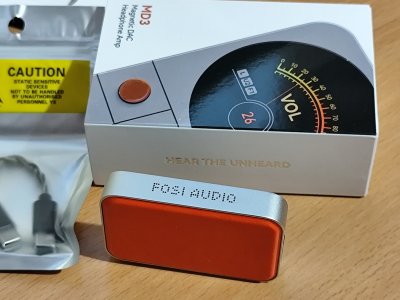
The back orange leather cover is full extra quality:
However, I found an error when I took a closer look at the connections. When using the bottom USB socket, the thick 3.5 mm jack plug doesn't fit next to it. We can't plug it in like that. This is not very good.. Normal thickness ones will fit, such as the Fosi im4 plug. Of course, there is the upper USB socket instead of the lower one, if we were to use a thick 3.5 mm jack plug, but the factory USB cable is short anyway and if we turn it around, We need to adjust the display rotation and the buttons will be different, and the headphone cable will also face the other way… … ahhh let's leave it..
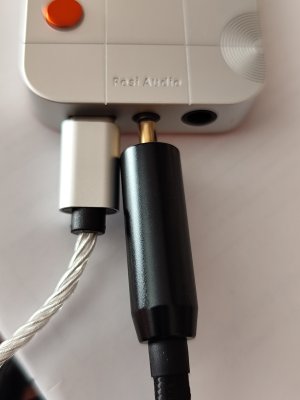
For a phone, it's better if the 3.5 mm jack is normal size. For a laptop, however, the upper USB is good and the thick jack can go at the bottom. I'll note here that it's easy to turn the display in the menu.
Sound:
I think the sound is completely neutral. Excellent quality. Without exaggerations, natural. I like the sound of the saxophone at the beginning of Dire Straits – Your latest trick, if this part is to be believed (live and naturallic sound) , then the sound will usually be okay with the other test recordings. It's okay here, I really like it. There is complete silence in the breaks and every sound is in its place. The bass is good too, I didn't feel any lack or exaggeration in either the mids or the highs. The space is also very good. We find variable digital filters. Who likes what, you can adjust it to your own ears. The Fosi IM4 is a perfect pair with the earphones. The sound is strong. airy and instrument-accurate. The i5 planar also reaches sufficient volume and the sound is also fine with the MD3, but the lack of sufficient power reserve is noticeable in the lows. In jazz and rock recordings, the piano, guitar, and vocals are also excellent. The wind instruments, drums, and cymbals are all alive. They can be enjoyed with your eyes closed.
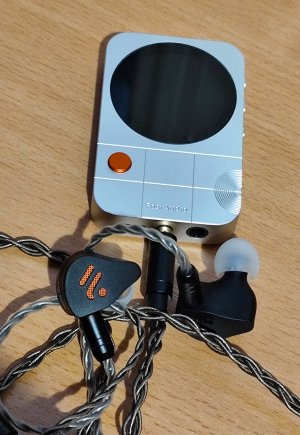
MD3 vs DS3:
Both products sound very good. Unfortunately, the MD3 is inferior to the DS3 in all areas of performance, including signal processing and volume. It is true that the MD3 is much prettier and the display helps a lot in finding the functions available from the menu. However, the display is almost only visible indoors. It is completely invisible in strong sunlight outside. The games and the image viewer would have been really useful functions if the MD3 was not a dac/headphone amp, but a complete playback system with its own internal or expandable storage, its own built-in battery. So it would be the only one thing hanging on the earphone cord and then you could play games and watch pictures on it. However, since the phone is already at hand, these functions lose their meaning, because the phone has a large and clearly visible display and sufficient hardware to run more serious games. This in itself would not be a problem, as they are not mandatory to use. However, due to the extra power consumption due to images and games, the performance had to be optimized. Simply put, the signal processing of the dac was reduced by half, and the output volume was also weaker. Half of my test songs (dsd512) cannot be played with it, unless I set the output of the player application on my phone to pcm. But the MD3 is a dac that has a chip capable of processing dsd512. I don't want to prepare the format for it. Let's use the dac chip to its full capacity! Whether the source is a phone, laptop or tablet, the display is already large and of excellent quality. It is worth taking advantage of the large housing size of the MD3 to increase the power of the amplifier. This is an audio device. It needs to be optimized to audio processing the maximum. At least that's what I think.
Final recommandation:
For those who don't need very high signal processing and are satisfied with this volume level, which is sufficient to drive IEM headphones, the MD3 is a very good choice because it really looks luxurious and the display is also sophisticated and beautiful! Its sound quality is excellent. It is really incredible to hear faithful instrument sounds. It serves Tidal and other lossless streaming services well, I only had problems when playing my test songs. But since it is a DAC, maximum knowledge is important to me, especially since the built-in DAC chip can do this. For my part, the MD3 is definitely recommended and if I compare it to the DS3, I would choose the DS3 because of the signal processing and the much smaller size. It is true that the volume of the little brother DS3 is also higher, but it is not such a difference that I would give up the beautiful display because of it. Fosi has put a beautiful device and excellent sound on the table again. I really like it anyway, but I would change it like this, and it would be a hit for me, but that's just my personal opinion. However, it is completely fine for current streaming services!
Pro:
Premium quality materials
Spectacular display.
Very good sound.
Excellent handling.
Volume memory.
100-step volume control.
Good and easy-to-understand menu.
Good cables (2 pcs)
Low consumption.
Negative:
Large device.
Excessively foregrounded display utilization (games, pictures, gifs..) because of this, signal processing and volume are more restrained.
When using the bottom USB socket, the thick-bodied 3.5mm jack cannot fit next to it.
If you liked it, please read my other presentations.
by: Antal István
Let's open it and see what's in the nice design box:
MD3 dac/headphone amp
Two USB cables in two different designs.
User manual
The MD3 is simply beautiful in this silver color to me. The aluminum housing with the round display and the orange leather covering on the back on the magnet exude a kind of luxury. This protects both the phone and the MD3 itself from scratches that could occur when rubbing against the back of the phone. The use of materials: Aluminum housing and leather milled from a single block, the display is a 1.28' LCD. In any case.
I have an extra luxurious feeling.
On the top there is a usb-c socket, and on the bottom from left to right there is a usb-c socket, then a 3.5mm jack and finally a 4.4mm jack balanced output.
The two usb outputs can be used equally to receive music and image files, and the one on the bottom can also receive updates. It is also suitable for charging the phone while in use. The design of the two usb cables is different so that the MD3 can cover all kinds of situations when placed on the phone or even when using a laptop, tablet, etc. This is a good point.
Some technical data, but only tangentially. They can be found in detail on the manufacturer and distributor's website. There is no point in repeating the manufacturer's data in a user test. The dac chip: ES9039Q2M flagship chip.
The picture should tell the story about the performance, frequency transfer, power consumption, etc.:
The big and little brothers next to each other:
Let's plug it into the phone and see what it this:
It has a very nice display. The picture is sharp and the brightness is adjustable. This VU meter is beautiful. It's a pity that it's not a working meter, or at least an animated image. However, if we switch, there's a tape cassette reel that rotates and a vinyl record, very cool. It's really a shame about the VU meter, it would have been nice even if it didn't show real data, only random moved. However, it shows the volume level setting, so it still has a function. Overall, the animations look very good. We can also view images on the MD3's display. Although the phone at hand or other device connected to the dac can do this on its own. There is a web application for the MD3 that allows you to edit images and upload them to the DS3 dac. Link:
Fosi Audio Control Center - Professional Audio Device Management | DS3, C3, MD3, Q8
Official web control center for Fosi Audio DS3, C3, MD3, Q8 and premium audio devices. Advanced EQ and PEQ control, firmware updates, spatial audio, AI-powered gaming audio enhancement, and image processing tools.
cc.fosiaudio.com
The menu is clear and easy to use. The display can be rotated, so you can use the device in any position. Of course, it can be used not only with mobile devices. The dac/amplifier is also suitable for other devices.
The magnetic back is only possible with many devices by using a suitable case, or a self-adhesive magnetic or metal disc, since many devices have glass or full aluminum housings.
We can see that despite the more than twice the size, the MD3 lags behind its little brother the DS3 in terms of output power, which is even a little stronger on the balanced output (4,4mm). However, its volume is still enough to drive IEMs. I would have actually preferred to see extra volume power at least on the 4.4mm balanced output instead of games, because the phone behind the DS3 has a bigger and better display than the dac stuck to the back anyway. However, it's really good and gives you more than the dac/ampok without a display. The larger size was more necessary because of the display.
The handling is absolutely good. It didn't cause any difficulties. I found everything in the menu easily. The combination of the three side silver and front big orange buttons helped me with everything. The volume can be adjusted in 100 steps and is also supplemented with a volume memory and this is really good. The many steps allow for fine adjustment.
Magnetic back cover: If you are worried about the effect of strong magnets on the sound, according to the manufacturer, there is no reason for this because the aluminum insulating sheet isolates the magnets. I certainly didn't notice anything that would have resulted from this. There is no harmful interference.
The back orange leather cover is full extra quality:
However, I found an error when I took a closer look at the connections. When using the bottom USB socket, the thick 3.5 mm jack plug doesn't fit next to it. We can't plug it in like that. This is not very good.. Normal thickness ones will fit, such as the Fosi im4 plug. Of course, there is the upper USB socket instead of the lower one, if we were to use a thick 3.5 mm jack plug, but the factory USB cable is short anyway and if we turn it around, We need to adjust the display rotation and the buttons will be different, and the headphone cable will also face the other way… … ahhh let's leave it..
For a phone, it's better if the 3.5 mm jack is normal size. For a laptop, however, the upper USB is good and the thick jack can go at the bottom. I'll note here that it's easy to turn the display in the menu.
Sound:
I think the sound is completely neutral. Excellent quality. Without exaggerations, natural. I like the sound of the saxophone at the beginning of Dire Straits – Your latest trick, if this part is to be believed (live and naturallic sound) , then the sound will usually be okay with the other test recordings. It's okay here, I really like it. There is complete silence in the breaks and every sound is in its place. The bass is good too, I didn't feel any lack or exaggeration in either the mids or the highs. The space is also very good. We find variable digital filters. Who likes what, you can adjust it to your own ears. The Fosi IM4 is a perfect pair with the earphones. The sound is strong. airy and instrument-accurate. The i5 planar also reaches sufficient volume and the sound is also fine with the MD3, but the lack of sufficient power reserve is noticeable in the lows. In jazz and rock recordings, the piano, guitar, and vocals are also excellent. The wind instruments, drums, and cymbals are all alive. They can be enjoyed with your eyes closed.
MD3 vs DS3:
Both products sound very good. Unfortunately, the MD3 is inferior to the DS3 in all areas of performance, including signal processing and volume. It is true that the MD3 is much prettier and the display helps a lot in finding the functions available from the menu. However, the display is almost only visible indoors. It is completely invisible in strong sunlight outside. The games and the image viewer would have been really useful functions if the MD3 was not a dac/headphone amp, but a complete playback system with its own internal or expandable storage, its own built-in battery. So it would be the only one thing hanging on the earphone cord and then you could play games and watch pictures on it. However, since the phone is already at hand, these functions lose their meaning, because the phone has a large and clearly visible display and sufficient hardware to run more serious games. This in itself would not be a problem, as they are not mandatory to use. However, due to the extra power consumption due to images and games, the performance had to be optimized. Simply put, the signal processing of the dac was reduced by half, and the output volume was also weaker. Half of my test songs (dsd512) cannot be played with it, unless I set the output of the player application on my phone to pcm. But the MD3 is a dac that has a chip capable of processing dsd512. I don't want to prepare the format for it. Let's use the dac chip to its full capacity! Whether the source is a phone, laptop or tablet, the display is already large and of excellent quality. It is worth taking advantage of the large housing size of the MD3 to increase the power of the amplifier. This is an audio device. It needs to be optimized to audio processing the maximum. At least that's what I think.
Final recommandation:
For those who don't need very high signal processing and are satisfied with this volume level, which is sufficient to drive IEM headphones, the MD3 is a very good choice because it really looks luxurious and the display is also sophisticated and beautiful! Its sound quality is excellent. It is really incredible to hear faithful instrument sounds. It serves Tidal and other lossless streaming services well, I only had problems when playing my test songs. But since it is a DAC, maximum knowledge is important to me, especially since the built-in DAC chip can do this. For my part, the MD3 is definitely recommended and if I compare it to the DS3, I would choose the DS3 because of the signal processing and the much smaller size. It is true that the volume of the little brother DS3 is also higher, but it is not such a difference that I would give up the beautiful display because of it. Fosi has put a beautiful device and excellent sound on the table again. I really like it anyway, but I would change it like this, and it would be a hit for me, but that's just my personal opinion. However, it is completely fine for current streaming services!
Pro:
Premium quality materials
Spectacular display.
Very good sound.
Excellent handling.
Volume memory.
100-step volume control.
Good and easy-to-understand menu.
Good cables (2 pcs)
Low consumption.
Negative:
Large device.
Excessively foregrounded display utilization (games, pictures, gifs..) because of this, signal processing and volume are more restrained.
When using the bottom USB socket, the thick-bodied 3.5mm jack cannot fit next to it.
If you liked it, please read my other presentations.
by: Antal István